
The business world includes influential executives who shape major companies, influence investment decisions, and guide industries through periods of change. Brian Roberts and Amy Hood are two examples of leaders associated with some of America’s best-known corporations. One is connected with Comcast, a major media and telecommunications company, while the other plays an important financial leadership role at Microsoft.
People searching for these executives often want to understand their backgrounds, professional achievements, and possible connections. Are they related? Have they worked together? Do their companies share a business history?
The important distinction is that these executives have separate careers and responsibilities. Their names appearing together does not establish a personal relationship. However, the historical relationship between Comcast and Microsoft provides an interesting business connection worth exploring.
Who Is Brian Roberts?
Brian L. Roberts is an American business executive known for his long association with Comcast Corporation. He is the company’s Chairman and Co-Chief Executive Officer. His leadership has helped shape Comcast’s development from a cable television operator into a major organization involved in broadband, entertainment, media, and technology.
Roberts is the son of Ralph J. Roberts, who founded Comcast. Growing up in a family connected to the communications industry gave him early exposure to business operations and corporate development.
He attended the Wharton School at the University of Pennsylvania, where he graduated in 1981. After completing his education, he joined Comcast and began building his professional career within the company.
In 1990, he became president of Comcast. His responsibilities expanded as the organization entered new markets and developed additional services. He later became chief executive officer in 2002 and chairman in 2004.
Brian Roberts’ Career and Achievements
One of the defining features of Roberts’ career is his involvement in Comcast’s long-term expansion. Under his leadership, the company completed several important transactions and developed a wider business portfolio.
The acquisition of AT&T Broadband in 2002 significantly expanded Comcast’s cable operations. It strengthened the company’s position in the American telecommunications market and increased its ability to provide internet and television services.
Another important development was Comcast’s acquisition of a controlling interest in NBCUniversal in 2011. This transaction brought television networks, film production, entertainment content, and other media operations into the company’s portfolio.
In 2018, Comcast completed its acquisition of Sky, expanding its presence in European media and telecommunications markets.
These developments demonstrate how Comcast moved beyond traditional cable television. Its operations now include broadband connectivity, wireless services, streaming entertainment, television production, and theme park experiences.
Roberts’ leadership has also involved responding to industry changes. Consumers increasingly use streaming platforms, mobile devices, and internet-based entertainment services. This creates pressure on traditional television businesses to adapt.
For Comcast, maintaining strong broadband services while developing new entertainment opportunities remains an important strategic challenge.
Who Is Amy Hood?

Amy Hood is Microsoft’s Executive Vice President and Chief Financial Officer. She is responsible for leading the company’s worldwide finance organization and helping manage its financial planning, reporting, acquisitions, and investment decisions.
Her professional background combines financial services experience with extensive work in the technology industry.
Hood studied economics at Duke University before earning a Master of Business Administration from Harvard University. Before joining Microsoft, she worked at Goldman Sachs, where she gained experience in investment banking and capital markets.
She joined Microsoft in December 2002. During her early years at the company, she worked in different finance and business development positions.
Her responsibilities gradually expanded. She became closely involved in financial planning for Microsoft’s business operations and developed experience in managing large technology-related investments.
In May 2013, Microsoft appointed her as its Chief Financial Officer. This position placed her among the company’s most important senior executives.
Amy Hood’s Responsibilities at Microsoft
A chief financial officer does much more than prepare financial statements. At a large technology company, the role involves evaluating investments, managing financial risks, planning budgets, and supporting decisions about future growth.
Hood leads Microsoft’s worldwide finance organization. Her responsibilities include accounting, financial reporting, treasury, tax planning, investor relations, and financial analysis.
Microsoft operates across several major areas, including cloud computing, business software, gaming, artificial intelligence, and enterprise technology. Each area requires investment and careful financial planning.
For example, cloud computing requires substantial infrastructure. Companies must invest in data centers, servers, networking equipment, and other resources to support customer demand.
Artificial intelligence also creates new financial considerations. Developing and operating advanced AI services requires computing capacity, research, infrastructure, and long-term investment.
Hood’s financial leadership helps Microsoft evaluate these requirements while maintaining financial discipline.
She has also contributed to the financial planning surrounding important acquisitions, including LinkedIn, GitHub, and Activision Blizzard. These transactions expanded Microsoft’s activities in professional networking, software development, and gaming.
Her career demonstrates that financial executives can influence corporate strategy rather than simply monitor spending.
Why Are Brian Roberts and Amy Hood Mentioned Together?
There are several possible reasons people encounter these two names together online.
First, both executives hold senior positions at influential American corporations. Their professional responsibilities involve large organizations, substantial investments, and industries that affect millions of customers.
Second, Comcast and Microsoft operate in areas that sometimes overlap. Broadband connectivity, digital entertainment, cloud computing, and internet services are connected parts of the modern technology economy.
Third, online articles and search results sometimes group executives together when discussing business leadership, corporate history, or influential company figures.
However, appearing together in search results does not establish a personal or professional relationship.
When examining this topic, it is important to distinguish confirmed corporate information from assumptions based on similar industries or online discussions.
Are Brian Roberts and Amy Hood Related?
There is no established public evidence that Brian Roberts and Amy Hood are immediate family members or married to one another.
Their publicly documented professional biographies describe different backgrounds and separate career paths.
Roberts is closely associated with Comcast, the company founded by his father. Hood developed her professional experience through financial services and her subsequent career at Microsoft.
Neither company’s official leadership biography identifies the other executive as a family member or direct business partner.
It is also important not to make unsupported claims about private relationships. Public information can establish professional positions and documented corporate activities, but it cannot answer every question about someone’s private acquaintances.
The most responsible conclusion is that no verified family or marital relationship between these executives has been established in the public information reviewed.
The Historical Business Connection Between Comcast and Microsoft
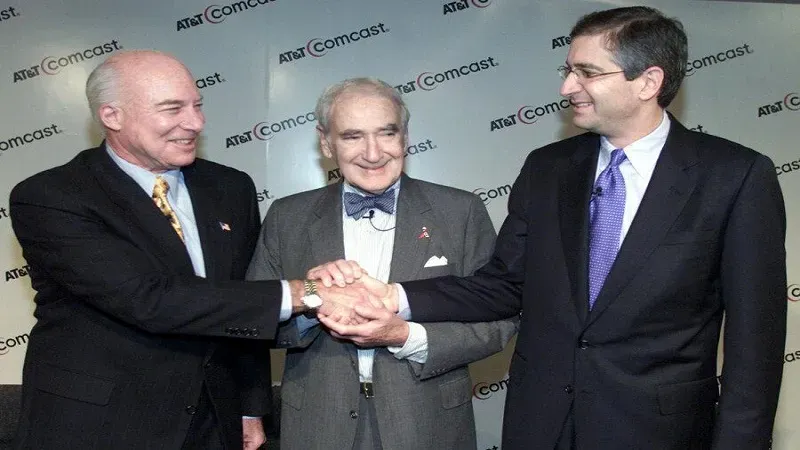
Although the executives have separate careers, their companies have a documented historical connection.
On June 9, 1997, Microsoft announced a $1 billion investment in Comcast. The investment was intended to support the development of high-speed data and video services through Comcast’s cable network.
At the time, internet technology was developing rapidly. Cable infrastructure offered an opportunity to deliver faster internet connections and additional digital services to households and businesses.
Microsoft saw potential in the relationship between personal computers, television, and broadband connectivity. Comcast, meanwhile, could use the investment to support the development of its network.
Brian Roberts was Comcast’s president during this period and participated in the announcement.
However, Amy Hood joined Microsoft in December 2002. This means she was not part of Microsoft’s leadership team when the 1997 investment was announced.
This historical detail is particularly important because it prevents readers from confusing a company-level business relationship with a direct partnership between two executives.
The investment demonstrates that Comcast and Microsoft had a significant corporate connection before Hood began her Microsoft career.
Comparing Their Professional Leadership Styles
The careers of these executives offer two different examples of leadership within large organizations.
Roberts’ work focuses on overall corporate direction, strategic transactions, business development, and the management of a major media and telecommunications company.
Hood’s work focuses on financial planning, investment decisions, resource allocation, and financial reporting within a global technology organization.
Their responsibilities differ, but both positions require an understanding of long-term business objectives.
A chief executive must consider the company’s overall direction, market position, employees, customers, and shareholders. A chief financial officer must understand how financial resources can support those objectives.
Both roles require communication, careful judgment, and the ability to respond to changing market conditions.
Their careers also demonstrate that successful corporate leadership can develop through different professional routes. Roberts built his career within a family-founded organization, while Hood progressed through investment banking and corporate finance.
How Their Companies Influence Modern Technology
Comcast and Microsoft operate in different sectors, but their businesses are connected to the wider digital economy.
Comcast provides broadband, connectivity, entertainment, and media services. Reliable internet infrastructure allows households and businesses to access digital platforms, communicate online, and use cloud-based services.
Microsoft develops software, cloud computing platforms, business applications, gaming products, and artificial intelligence services.
These industries depend on one another in several ways.
Streaming entertainment requires reliable internet connections. Cloud computing requires advanced network infrastructure. Online gaming depends on software platforms and connectivity. Businesses also need digital tools that help employees communicate and manage information.
This relationship illustrates why media and technology companies sometimes have overlapping commercial interests.
Nevertheless, similarities between their industries should not be confused with evidence of a personal partnership between individual executives.
What Can Readers Learn From Their Careers?
There are several useful lessons in examining these professional journeys.
The first is the importance of industry knowledge. Roberts developed extensive experience in communications and media through decades of work at Comcast. Hood developed financial expertise through banking and corporate finance before taking a senior role at Microsoft.
The second lesson is that leadership requires adaptation. Both companies have experienced major changes in technology, customer expectations, and competition.
The third lesson is the value of strategic thinking. Large organizations must balance immediate financial requirements with investments that may produce benefits over many years.
Finally, professional success does not follow one fixed path. Different educational backgrounds and career experiences can lead to influential leadership positions.
Frequently Asked Questions
Who are Brian Roberts and Amy Hood?
Brian Roberts is the Chairman and Co-CEO of Comcast Corporation. Amy Hood is the Executive Vice President and Chief Financial Officer of Microsoft. Both are established business executives with different professional responsibilities.
Are Brian Roberts and Amy Hood related?
No publicly established evidence identifies them as immediate family members or spouses. Their official professional biographies describe separate backgrounds and careers.
Do Brian Roberts and Amy Hood work for the same company?
No. Roberts is associated with Comcast, while Hood works at Microsoft. They hold senior positions within separate organizations.
What is the connection between Microsoft and Comcast?
Microsoft announced a $1 billion investment in Comcast in June 1997. The investment supported the development of high-speed data and video services through Comcast’s cable network.
Was Amy Hood involved in Microsoft’s 1997 investment in Comcast?
No. Hood joined Microsoft in December 2002, approximately five years after the investment was announced.
What is Brian Roberts known for?
He is known for his long leadership career at Comcast and his involvement in the company’s expansion into broadband, entertainment, and international media markets.
What is Amy Hood known for?
She is known for leading Microsoft’s worldwide finance organization and supporting the company’s financial planning, investment decisions, and major acquisitions.
Conclusion
Brian Roberts and Amy Hood represent two different forms of corporate leadership. Roberts has helped shape Comcast’s development across media, broadband, and entertainment, while Hood has played an important financial leadership role at Microsoft.
Although their names are sometimes discussed together, their professional histories should be understood separately. No established public evidence confirms a family relationship or direct executive partnership between them.
The most meaningful documented connection comes from the history of their companies. Microsoft’s $1 billion investment in Comcast in 1997 provides an important example of how technology and telecommunications businesses began working together during the early development of broadband services.
Understanding these distinctions allows readers to separate verified business history from unsupported assumptions and gain a clearer picture of both executives’ professional contributions.